Top strategic predictions for 2026: AI, project management, governance

Are you ready for the AI skills paradox? Gartner’s 2026 predictions reveal a future where AI reshapes not only business operations, but human thinking, global regulation, and economic power. The real question? Who controls AI—and who gets controlled.

Table of contents
AI is reshaping your business and your brain
Long-term predictions
The “too much AI” problem is real
Control AI before it controls your work
Lead the AI era
TL;DR
AI is set to redefine business, skills, and regulation by 2026; organisations must act now to govern it wisely or risk being left behind.
AI is reshaping your business and your brain
By 2027, more than 75% of hiring processes will require certification in workplace AI. That’s not a forecast. It’s a wake-up call.
As AI becomes embedded in everything from project workflows to customer service, it’s no longer just a tool. It’s a collaborator. A decision-maker. A threat and also an opportunity.
But with this comes an uncomfortable twist. As Gartner warns, the race to adopt AI may be quietly eroding a skill more valuable than any software: human critical thinking.
Long-term predictions
According to a Gartner overview, AI will reshape global business in terms of regulation and productivity within just a few years:
- AI becomes regionalised: By 2027, 35% of countries will be locked into region-specific AI platforms using proprietary contextual data.
- Regulation ramps up fast: By 2027, fragmented AI regulation will cover 50% of the global economy, triggering $5 billion in compliance investments.
- Service contracts get smarter: The cost-to-value gap for process-centric service contracts will drop by 50% by 2027, driven by agentic AI reinvention.
- AI powers customer experience: By 2028, organisations using multiagent AI for 80% of customer-facing processes will become industry leaders.
- Money gets programmable: By 2030, 20% of monetary transactions will include terms and conditions directly programmable into the transaction giving AI agents economic agency.
- A market shake-up is coming: Through 2027, the combined rise of AI and AI agents will create the first major challenge to productivity tools in 30 years, sparking a $58 billion disruption in the market.
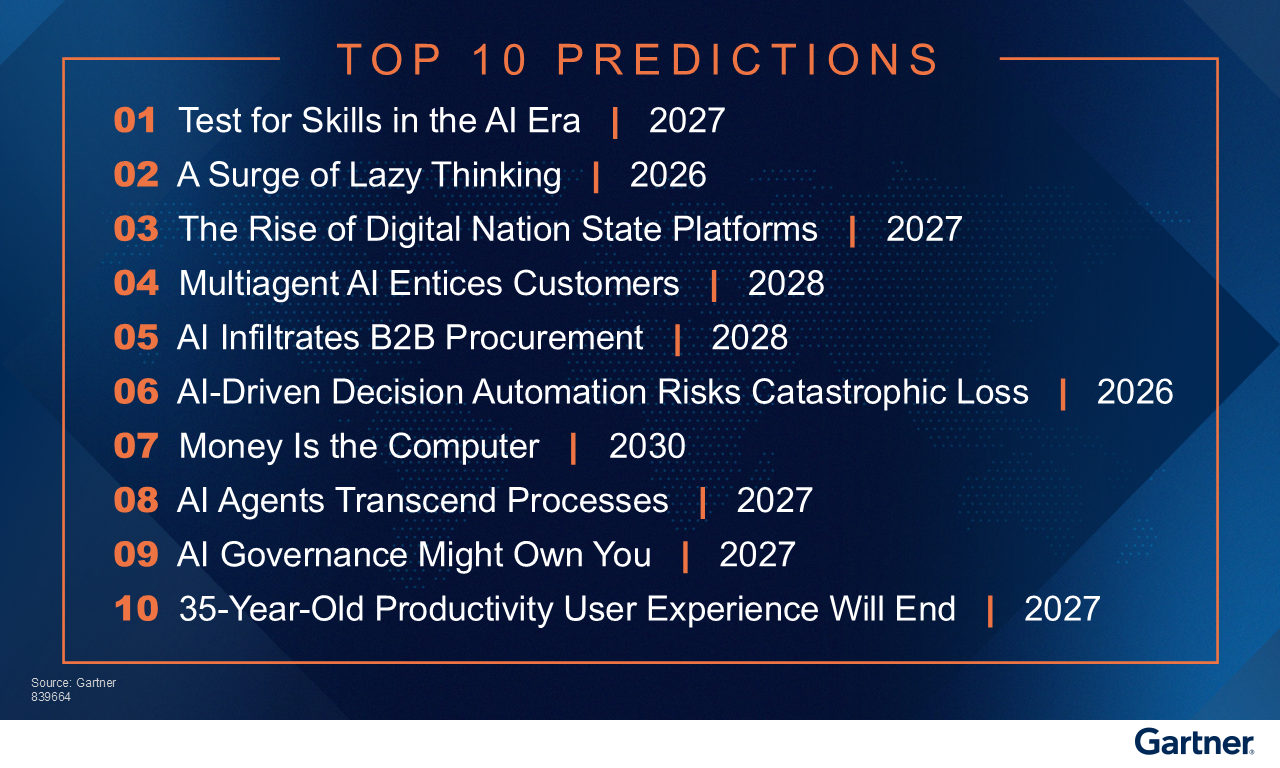
Top 10 strategic predictions for 2026 and beyond by Gartner
The “too much AI” problem is real
Imagine hiring someone who is too good at using AI. So good that they’ve stopped thinking for themselves. That’s the emerging paradox. Global organisations are already preparing by adding “AI-free” assessments to hiring tests.
And that’s just the start. As AI agents take over more customer-facing tasks, they’ll reshape $15 trillion in B2B spending by 2028. AI won’t just support your business. It will be your business.
But here’s the catch! Without the right systems and governance, your AI advantage could quickly become a risk. Gartner predicts over 2,000 “death by AI” legal claims by 2026 due to poor oversight.
Control AI before it controls your work
For technology service providers and enterprises, the path forward is clear: don’t just adopt AI. Integrate it intelligently.
That means tools that enhance, not replace, human judgment. That allow you to govern AI use, track its output, and secure the intellectual property it generates.
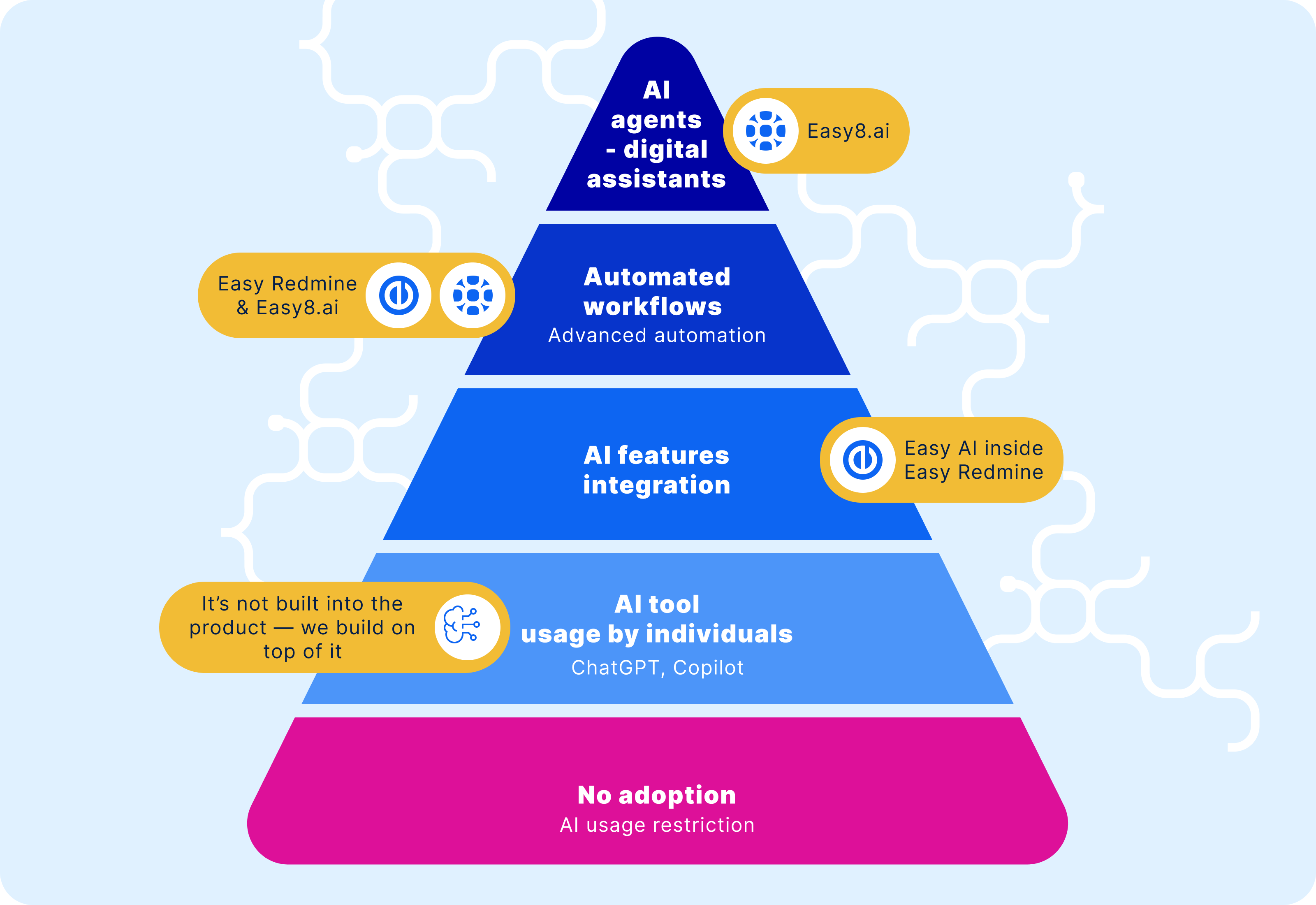
AI adoption pyramid
This is where Easy Redmine comes in. Our AI-powered project management software helps you:
- Stay in control of AI use through scenario-based resource planning and transparent dashboards
- Maintain human visibility with AI-powered assistants that summarise, not override, your team’s thinking
- Meet new compliance standards with on-premises AI and full auditability
And while others struggle with disjointed tools and blurred accountability, Easy brings everything from project management, ITSM, SCM, to AI integration into one secure platform.
Lead the AI era
The future of AI isn't just about technology, it’s about people, processes, and priorities. As AI becomes more embedded in our systems, its impact will extend far beyond productivity, reshaping human behaviour, and geopolitical landscapes.
For business and technology leaders, the challenge is not only to adopt AI but to govern it wisely. This means treating behavioural change as a core business strategy, not a side effect, and preparing teams to navigate the ethical, and operational shifts AI will bring.
Organisations must also establish internal governance frameworks to track evolving regulations and ensure responsible AI usage. In short, those who succeed won’t just integrate AI into their workflows—they’ll integrate it thoughtfully into their culture, values, and strategy.
The AI future isn’t waiting for you. Your competitors are already embedding it into their processes. The question is: Will you lead, or will you be disrupted? To be ready, get a consultation with our sales team!
Frequently asked questions
Related articles

The WorkOps framework: A new functional model of work
Do you also feel like there is no longer a language to adequately describe modern work? Well, it is because you are not familiar with the WorkOps approach yet. Read more to realise why it all makes sense!

AI adoption survey 2025 by Easy Redmine: Real insights to AI maturity
Our 2025 AI adoption maturity survey cuts through the hype to show what’s really happening with AI in organisations: plenty of experimentation, little coordination, and growing security risks from unmanaged public-cloud tools. See how your organisation compares! And where the biggest gaps in AI maturity still are.

The AI adoption curve: Where companies really are in 2026
AI is no longer a futuristic concept. It's a present-day power play reshaping how companies compete, grow, and operate. But while many businesses have jumped on the AI wave, only a few know how to turn potential into performance. Do you know where your organization stands?