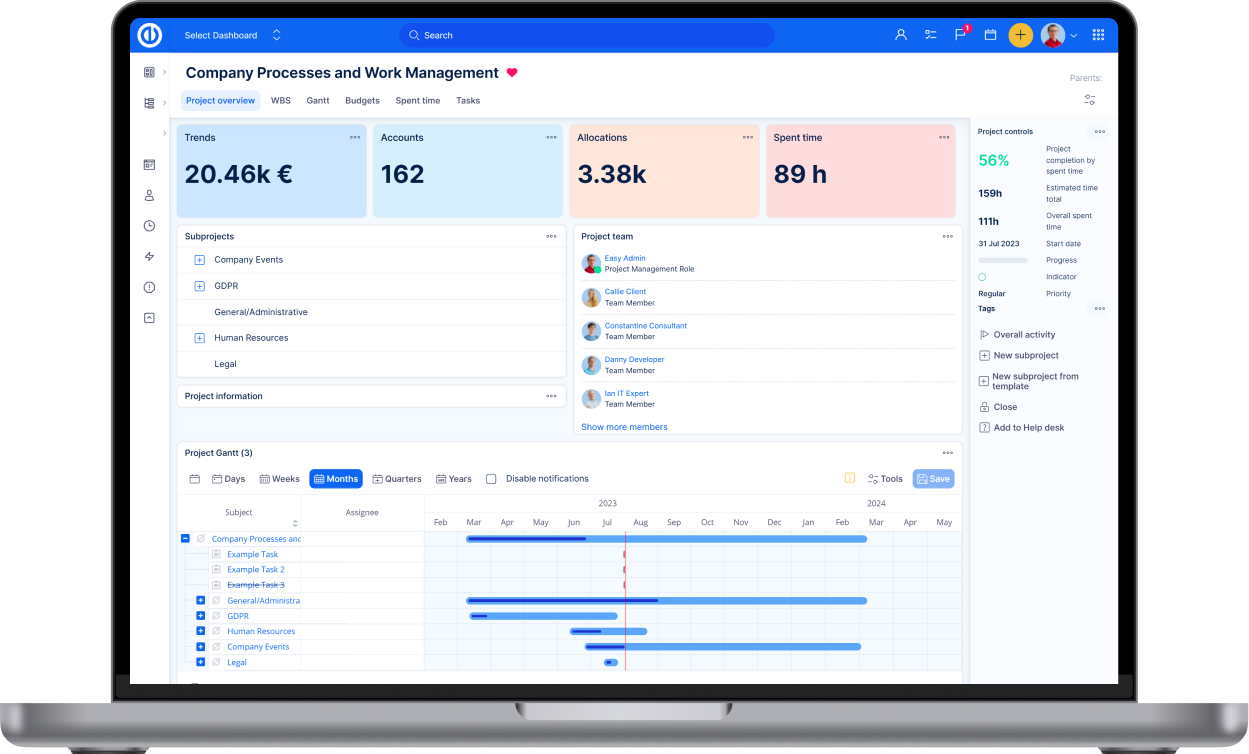
The WorkOps framework: A new functional model of work

Do you also feel like there is no longer a language to adequately describe modern work? Well, it is because you are not familiar with the WorkOps approach yet. Read more to realise why it all makes sense!

Table of contents
Changing mindset in project management
From command to flow
Why the Distributed model is not enough
Flow model as WorkOps in practice
Implementing WorkOps framework with Easy Redmine and Easy8
TL;DR
WorkOps replaces outdated work models by creating a flexible, continuous ecosystem that aligns distributed teams, tools, and AI into a unified workflow, helping organisations move faster without losing coordination or visibility.
Changing mindset in project management
As organisations pursue digital transformation, they’re placing greater emphasis on supporting employees who don’t work in a standard office, such as remote staff, field teams, and mobile workers. To improve their productivity and engagement, companies need tools specifically designed to meet the demands of these distributed roles.
Also, terms like "project management" or "agile" no longer capture how new technologies are reshaping the way organisations function.
That is why Chris Marsh introduced the concept of WorkOps in 2018. Basically, it amplifies the technology-centric approach to understanding how work will actually get done in the future (which is now). The WorkOps framework transforms rigid “command” work models into adaptive “flow” systems by orchestrating teams, tools, and AI into a single, continuous ecosystem of work. It keeps the local speed of distributed teams while restoring alignment and visibility through integrated workflows, data, and automation.
But how did we in Easy find WorkOps to be the right solution for this situation?
From command to flow
You might be familiar with the two concepts of work models:
- Command model of work
- Distributed model of work
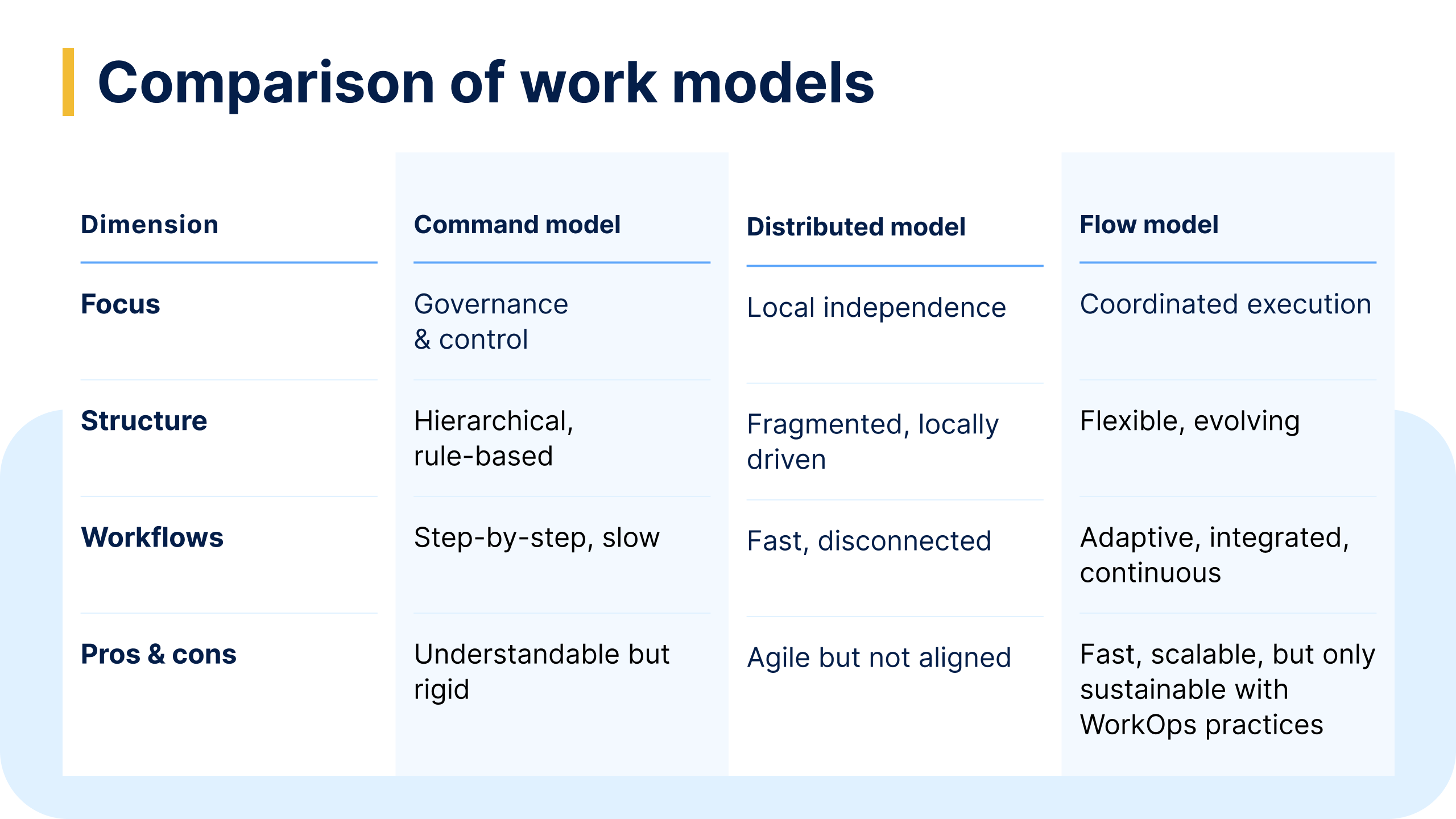
The Command model of work prioritizes control as the primary company objective. It follows a rigid organisational design, where processes are siloed and managed in isolation. It focuses on governance, central control, and strict rules, which makes work understandable but slow and rigid.
On the other hand, the Distributed model of work prioritises local autonomy over central control. Its organisational design is inconsistent, and processes are often disjointed across teams. The main trade-off is that while this model is fast, it is often uncoordinated.
Let me introduce you to the Flow model of work. In contrast with the mentioned models, a WorkOps-based flow model focuses on coordinated execution, where strategy, planning, and daily work run in one loop instead of disconnected phases.
To get oriented among all three mentioned models, dive deeper into the table illustrating the characteristics of each work model:
Why the Distributed model is not enough
Many organisations tried to escape command-and-control by adopting a Distributed model, giving local teams more independence and speed. While this created fast decision-making, it also produced fragmented processes, misaligned metrics, and tool sprawl across dozens of disconnected applications.
The report by 451 Research on modern productivity software shows that as workflows spread across more apps, the real work happens “between” tools, not inside them.
Without a unifying layer, this distributed execution becomes disjointed, making it hard to see end-to-end performance or learn systematically from outcomes.
Flow model as WorkOps in practice
The Flow model represents a coordinated, integrated way of working where teams move quickly but remain aligned through shared context, data, and goals.
WorkOps operationalises this by treating the organisation as an ecosystem and running work through an infinite loop of eight phases: Planning, Delivery, Quality, Reports, Automations, Integrations, Support, and Knowledge.
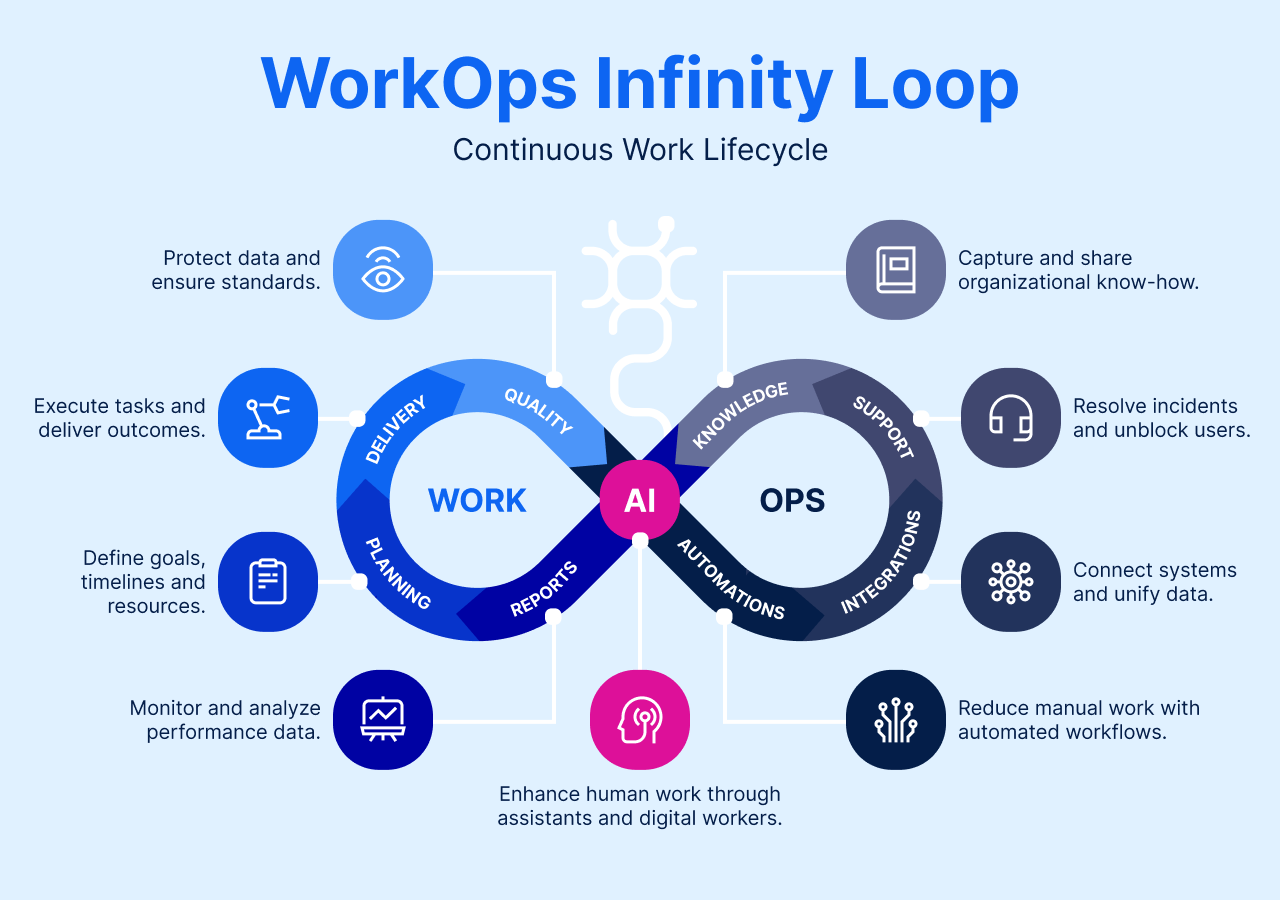
Because these phases are interconnected, every action, whether an automation, a support interaction, or a knowledge update, feeds back into planning and delivery. This is how the model stays “flexible, evolving” structurally and “adaptive, integrated, continuous” in workflows, just as the Flow column in the table suggests.
Simply put, WorkOps is to work what DevOps was to software.
Implementing WorkOps framework with Easy Redmine and Easy8
WorkOps reframes structure from fixed hierarchies into a flexible network of teams, systems, and automations that can reconfigure around changing priorities. This enables organisations to move from step-by-step workflows to adaptive, continuous flows of value that never really “stop” at project closure.
Platforms like Easy Redmine can act as the WorkOps “nervous system” that turns the theory into operational reality. By combining hybrid methodologies (Agile and Waterfall), n8n-powered integrations, AI-ready architecture, and centralised reporting, it provides one place where work, operations, and knowledge converge.
This unified WorkOps platform allows organisations to evolve from command or fragmented distributed models toward a sustainable flow model, ideally starting with high-value workflows, then extending automation, integrations, and knowledge over time. In doing so, project managers move from task administrators to WorkOps orchestrators, shaping the ecosystem in which continuous flow can thrive.
Ready to hop on the WorkOps framework? Contact our sales team to get a tailored consultation on where to start!
Frequently asked questions
Related articles

Introducing the Easy8 and n8n expert partnership
Easy8 is excited to announce a strategic partnership with workflow-automation innovator n8n. By combining Easy8’s deep consulting and implementation experience with n8n’s powerful, fair-code platform, we are making advanced automation accessible, and immediately beneficial for our clients.

Why is project management not enough? Future of WorkOps explained
Traditional project management was built for a predictable, linear world that no longer exists. Today's problems, such as siloed teams, tool fragmentation, and rapid change, require an ecosystem approach, not project-by-project oversight. WorkOps creates an intelligent, interconnected work environment where automation, AI and humans combine to deliver continuous value. Let's deep dive into the topic.

What is WorkOps?
First came DevOps to fix development, then RevOps to align revenue teams. Now WorkOps arrives to solve the biggest challenge yet: orchestrating how entire organisations get work done in an AI-powered, hyperconnected world. So, what is WorkOps?