WorkOS vs WorkOps: What is the difference

WorkOS is not the same as WorkOps. WorkOS is a developer platform for enterprise authentication features, while WorkOps is an operational methodology for unifying teams, processes, and tools into continuous workflows. Still not crystal clear? Continue reading!

Table of contents
WorkOS ≠ WorkOps
What is WorkOS
WorkOps: The framework
WorkOS vs WorkOps
WorkOps methodology meets WorkOS infrastructure
TL;DR
WorkOS is a developer platform that adds enterprise identity features (e.g., SSO/SCIM) to B2B SaaS apps, while WorkOps is an organizational framework for coordinating work and improving flow. They are not the same.
WorkOS ≠ WorkOps
Have you ever wondered if WorkOS and WorkOps represent the same meaning? Well, you cannot put an equals sign between WorkOS and WorkOps. Here is why!
What is WorkOS
WorkOS provides APIs and SDKs to add enterprise-ready capabilities like SSO, SCIM directory sync, user management, and audit logs to B2B SaaS applications. It enables quick integration with IdPs, focusing on developer efficiency.
Simply put, WorkOS is a developer platform that helps B2B SaaS companies add enterprise-grade identity and access features into their software quickly, to be concrete:
- Single Sign-On (SSO)
- Directory sync (SCIM)
- User management & auth
- Enterprise onboarding flows
built through simple APIs so you don’t have to build these complex systems yourself.
WorkOps: The framework
WorkOps was first mentioned and elaborated on by Chris Marsh in 2018.
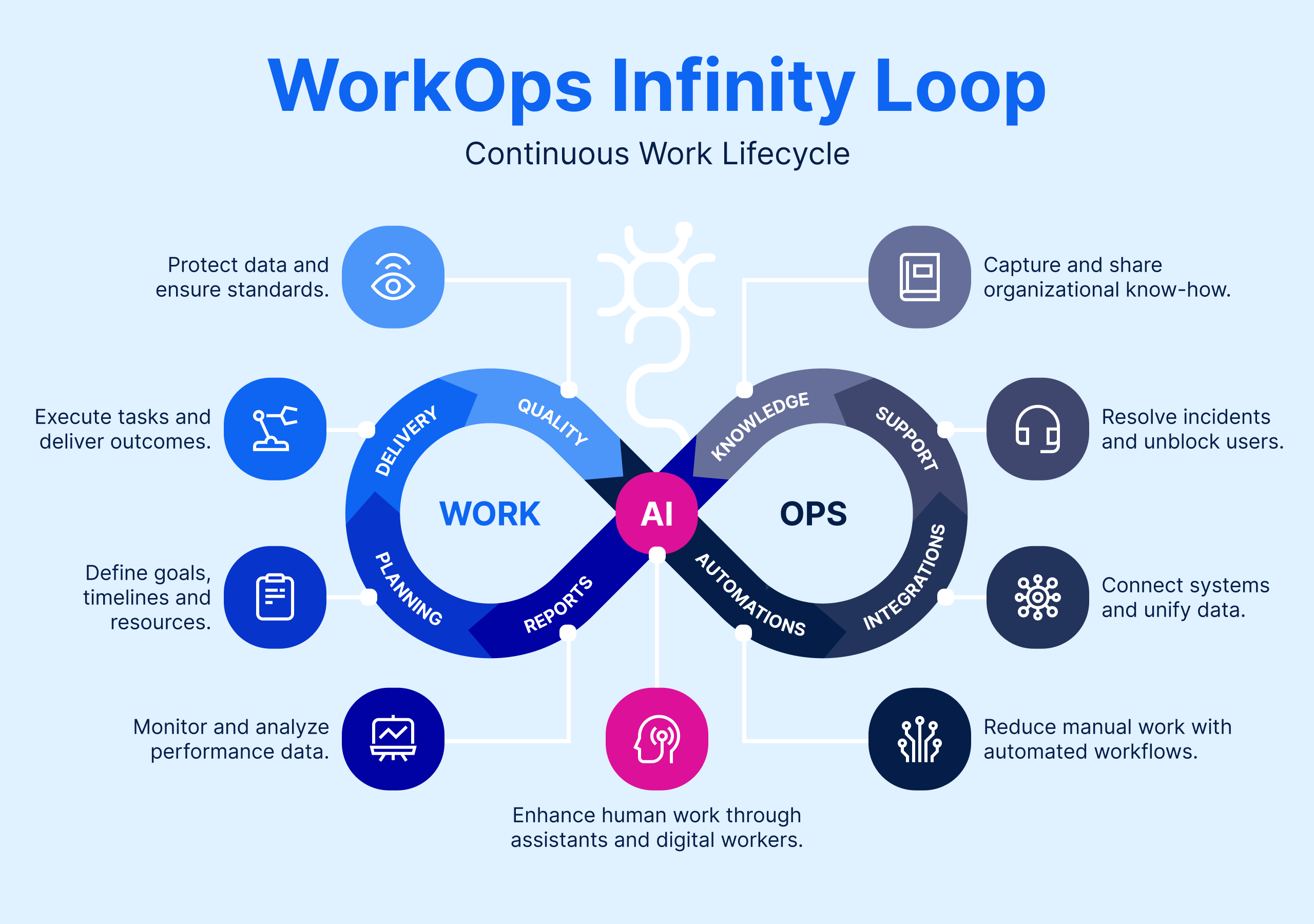
WorkOps (Work + Operations) is a framework that orchestrates teams, processes, technology, and AI into an interconnected ecosystem for continuous value delivery, evolving from DevOps principles.
It uses an infinite loop of eight phases (planning, delivery, quality, reports, automations, integrations, support, and knowledge) to create adaptive models over rigid command or fragmented distributed structures.
This framework brings more clarity to:
- Orchestrating how work actually happens across teams,
- Aligning planning, execution, automation, AI support, outcomes, and operations,
- Breaking down silos across functions to create a continuous workflow ecosystem rather than isolated departments or tools.
WorkOS vs WorkOps
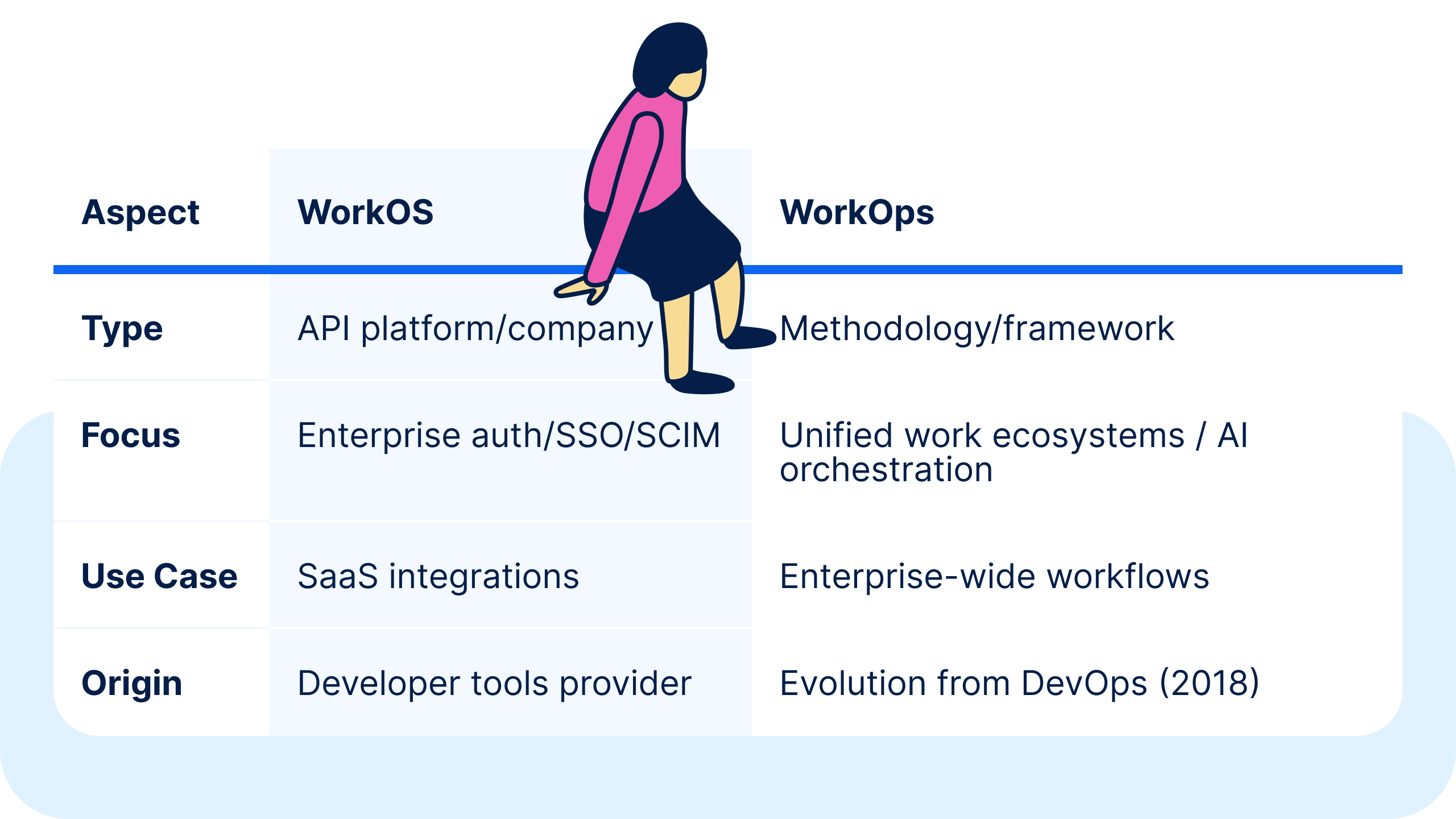
WorkOps is "project management on steroids", which can also be understood as modern collaborative management. WorkOps is about how work is structured and executed across the whole organisation, not about enterprise identity tech. It’s a methodology, and ecosystem concept, not a pure software kit like WorkOS.
On the other hand, WorkOS solves the technical problem of making apps enterprise-ready with minimal engineering effort. It’s about authentication, identity, security and integrations. It isn’t a productivity framework or methodology.
WorkOps methodology meets WorkOS infrastructure
WorkOps adoption helps enterprise teams achieve unified workflows, faster delivery, and reduced silos by extending DevOps to all operations. It fosters adaptability and AI integration for better resource use and decision-making.
While WorkOps represents a framework for coordinating work across an organisation to improve flow and results, WorkOS provides the technical foundation by managing secure, enterprise-grade user access in the tools that support that approach. It enables developers to add SSO, directory sync, and other identity features to their apps without building them from scratch.
Interested in the WorkOps framework? Contact our sales team to get a tailored consultation on where to start!
Frequently asked questions
Related articles

The WorkOps framework: A new functional model of work
Do you also feel like there is no longer a language to adequately describe modern work? Well, it is because you are not familiar with the WorkOps approach yet. Read more to realise why it all makes sense!

From DevOps to WorkOps: The evolution of the modern model of work
WorkOps is to technology project delivery what DevOps was to software development—bringing project, work, and service management into one integrated flow. Do you want to break this idea down? Continue reading...

Why is project management not enough? Future of WorkOps explained
Traditional project management was built for a predictable, linear world that no longer exists. Today's problems, such as siloed teams, tool fragmentation, and rapid change, require an ecosystem approach, not project-by-project oversight. WorkOps creates an intelligent, interconnected work environment where automation, AI and humans combine to deliver continuous value. Let's deep dive into the topic.