From DevOps to WorkOps: The evolution of the modern model of work

WorkOps is to technology project delivery what DevOps was to software development—bringing project, work, and service management into one integrated flow. Do you want to break this idea down? Continue reading...

Table of contents
When you hear DevOps...
The limits of DevOps in modern enterprises
DevOps vs. WorkOps
Scope
Teams involved
Core focus
Evolution: WorkOps is the next step of agile
What is not WorkOps?
Why implement WorkOps now?
TL;DR
DevOps transformed software delivery. WorkOps takes it further by unifying all types of work across the enterprise into one continuous, adaptive, AI-powered workflow. WorkOps is the evolution of agile.
When you hear DevOps...
You might be familiar with the times when DevOps emerged in the late 2000s to bridge silos between development and operations teams, accelerating software delivery through collaboration and automation.
Previously siloed roles were brought together around shared outcomes and accountability, and a clear end-to-end lifecycle from intake to improvement. Also, DevOps relies on automation, data, and feedback loops to improve speed, quality, and predictability over time.
The core idea behind DevOps is bringing development and operations together so people, processes, and technology stay aligned across the full application lifecycle, leading to faster and more reliable delivery.
The limits of DevOps in modern enterprises
DevOps reduces silos in tech stacks for reliable releases. This approach excels in IT by streamlining software development and operations through practices like continuous integration, delivery, and automation, reducing deployment times from weeks to hours.
On the other hand, DevOps falls short because it was designed to optimize software delivery in IT, so it does not translate well to non-technical, cross-functional workflows in marketing, HR, and sales where there are no code pipelines. It cannot resolve enterprise-wide silos that block end-to-end visibility.
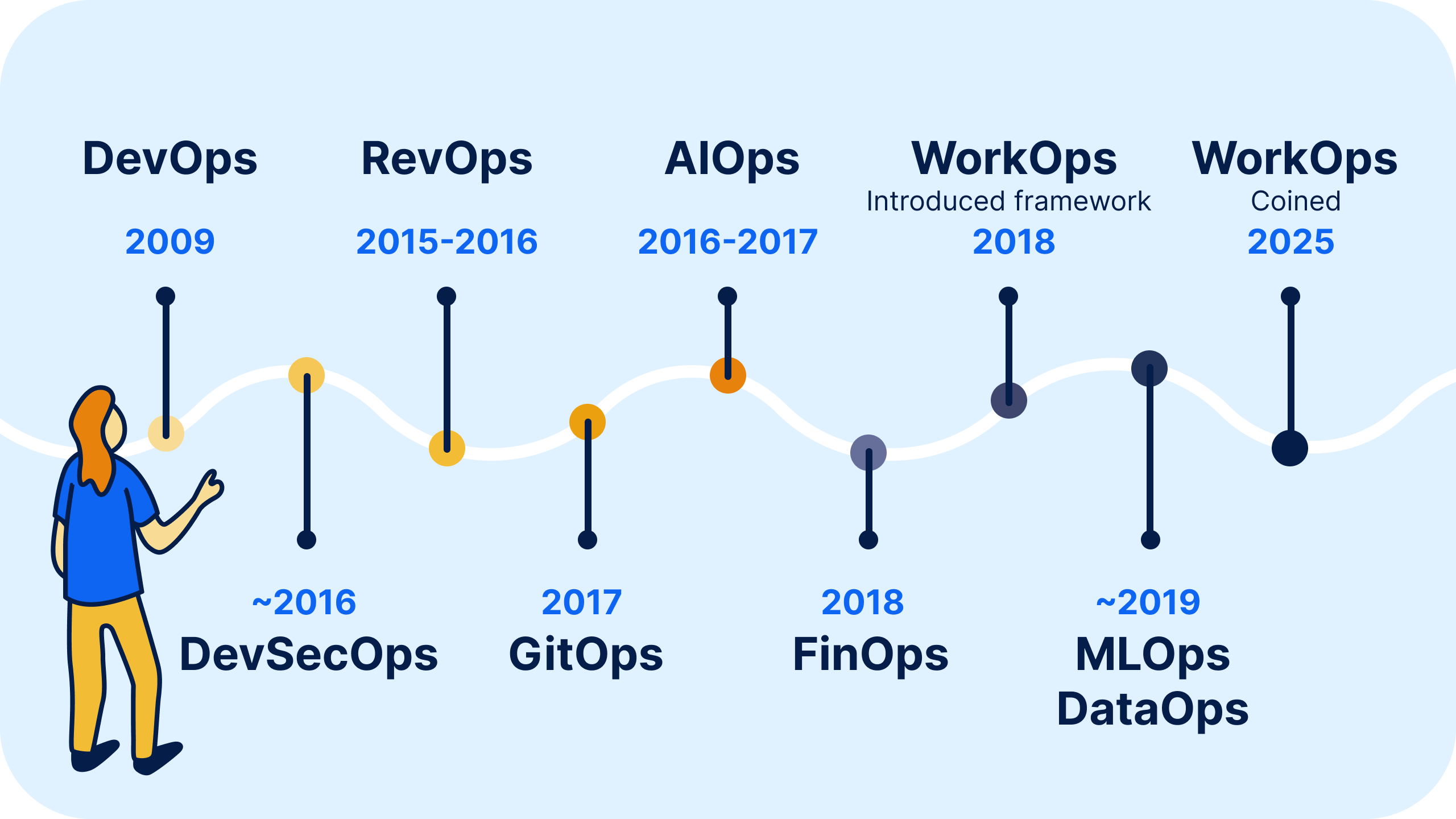
Evolution of DevOps and ‘Ops’ practices (2009 - 2025)
To cover all the diverse ecosystems of the organisation, WorkOps combines all work streams (e.g. RevOps for revenue teams) with operations to enable enterprise-wide agility. WorkOps promotes holistic agility by eliminating waste across operations.
DevOps vs. WorkOps
DevOps and WorkOps both promote collaboration and automation but differ in scope and application, with DevOps focusing on software delivery and WorkOps extending to broader enterprise workflows.
Scope
DevOps targets development and IT operations for faster software releases via CI/CD pipelines. WorkOps encompasses all work types—projects, services, tasks—unifying tools like ITSM platforms for end-to-end efficiency.
Teams involved
DevOps bridges developers and ops engineers. WorkOps involves diverse teams including service desks, PMs, and business units, aligning IT with business processes.
Core focus
DevOps bridges developers and ops engineers. WorkOps involves diverse teams including service desks, PMs, and business units, aligning IT with business processes.
| Aspect | DevOps | WorkOps |
|---|---|---|
| Primary Goal | Speed up code deployment | Optimize full work ecosystems |
| Tools | Jenkins, Docker, Kubernetes | Easy Redmine, Jira, automation hubs |
| Metrics | Deployment frequency, MTTR | Throughput, SLA compliance, ROI |
Evolution: WorkOps is the next step of agile
Just as DevOps = Development + Operations, WorkOps = All Work + Operations. This shift tackles fragmented tools in Jira-like ecosystems, centralizing tickets, projects, and services into one platform.
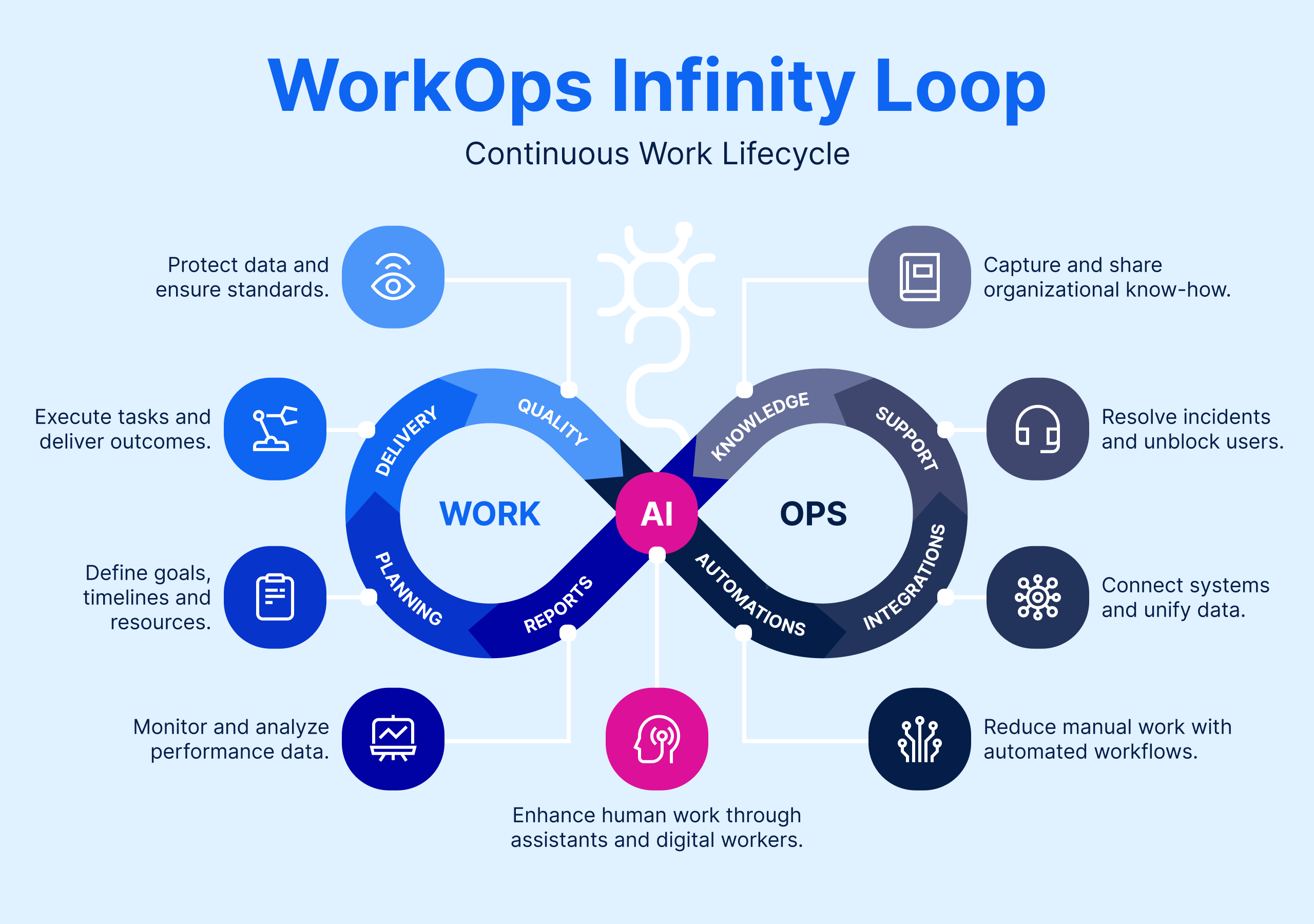
WorkOps loop schema
The WorkOps framework functions as an infinite loop of eight interconnected phases across work and operations, forming a self-improving system over time. It unifies planning, delivery, quality, and reporting with automation, integration, support, and knowledge to create a continuous, adaptive workflow.
The WorkOps framework, put into practice, will bring you:
- reduced tool fragmentation
- leverage your effectiveness with your existing tools and processes
- better visibility
- cross-functional alignment
What is not WorkOps?
It is important to clarify what WorkOps is not:
- Not project management: WorkOps focuses on the ongoing system of work across project and non-project work.
- Not just “work management software”: Gartner defines work management as software/services applying workflow structure to information movement and human/business processes; WorkOps is the operating discipline that selects, configures, governs, and measures that system.
- Not only automation: Automation is a pillar (like in DevOps), but WorkOps also requires governance, design standards, and measurement loops.
Why implement WorkOps now?
DevOps revolutionized software delivery by merging development and operations for faster, more reliable releases. Building on that logic, WorkOps extends the concept to unify all enterprise work with operations for end-to-end efficiency. This evolution from agile methodology reflects growing demands for holistic workflow automation in today's enterprises.
Enterprises face AI-driven complexity, needing beyond DevOps for cross-functional ops. WorkOps delivers unified workflows across teams, replacing silos with AI-powered ecosystems for continuous value in planning, delivery, quality, and operations.
Tools like Easy Redmine enable this via customizable workflows, knowledge bases, and automation. Try the WorkOps platform for free!
Frequently asked questions
Related articles

Why is project management not enough? Future of WorkOps explained
Traditional project management was built for a predictable, linear world that no longer exists. Today's problems, such as siloed teams, tool fragmentation, and rapid change, require an ecosystem approach, not project-by-project oversight. WorkOps creates an intelligent, interconnected work environment where automation, AI and humans combine to deliver continuous value. Let's deep dive into the topic.

What is WorkOps?
First came DevOps to fix development, then RevOps to align revenue teams. Now WorkOps arrives to solve the biggest challenge yet: orchestrating how entire organisations get work done in an AI-powered, hyperconnected world. So, what is WorkOps?

The AI adoption curve: Where companies really are in 2026
AI is no longer a futuristic concept. It's a present-day power play reshaping how companies compete, grow, and operate. But while many businesses have jumped on the AI wave, only a few know how to turn potential into performance. Do you know where your organization stands?