Hybrid cloud explained: Why the future of enterprise IT is hybrid

In today's accelerated environment of digital transformation, the cloud is no longer a fringe IT initiative. It is the foundation of business operations. Yet, for mid-to-large organisations navigating complex regulatory environments and massive legacy investments, the path forward is rarely all public cloud. Instead, a pragmatic, integrated approach has become the strategic standard: the hybrid cloud.

Table of contents
What is a hybrid cloud?
Decoding the cloud landscape: Enterprise deployment models
Hybrid cloud in practice: Matching workloads to environments
Key advantages of hybrid cloud architecture
1. Cost optimisation without compromise
2. Security and compliance by design
3. Resilience and business continuity
4. Agility without abandoning stability
Work ecosystem in hybrid cloud environments
Resilient hybrid cloud infrastructure
Unlock WorkOps in your hybrid cloud environment
TL;DR
Hybrid cloud combines on-premises control with public cloud agility, letting you keep sensitive data secure while scaling customer-facing apps elastically. According to Gartner, 90% of enterprises will adopt hybrid by 2027. Gartner's prediction is driven by the reality that "pure" cloud or "pure" on-prem models no longer meet modern business demands. The key is orchestration: matching each workload to its ideal environment based on security, cost, and performance needs. Easy Redmine supports this as a hybrid-cloud-friendly WorkOps platform.
What is a hybrid cloud?
At its simplest, a hybrid cloud is a computing environment that combines two different types of infrastructure, usually on-premises infrastructure (or private cloud) and a public cloud (like AWS, Azure, or Google Cloud), and connects them so they can work together.
Hybrid cloud lets you combine on-premises (or private cloud) control of sensitive customer data with public cloud capabilities for agility and scale, while integrating those environments so they can work together seamlessly.
The essence of modern hybrid cloud architecture is interoperability and orchestration, not mere coexistence. It focuses less on physical connections and more on ensuring the portability of workloads, automatically deploying them to the best environment for a specific business need.
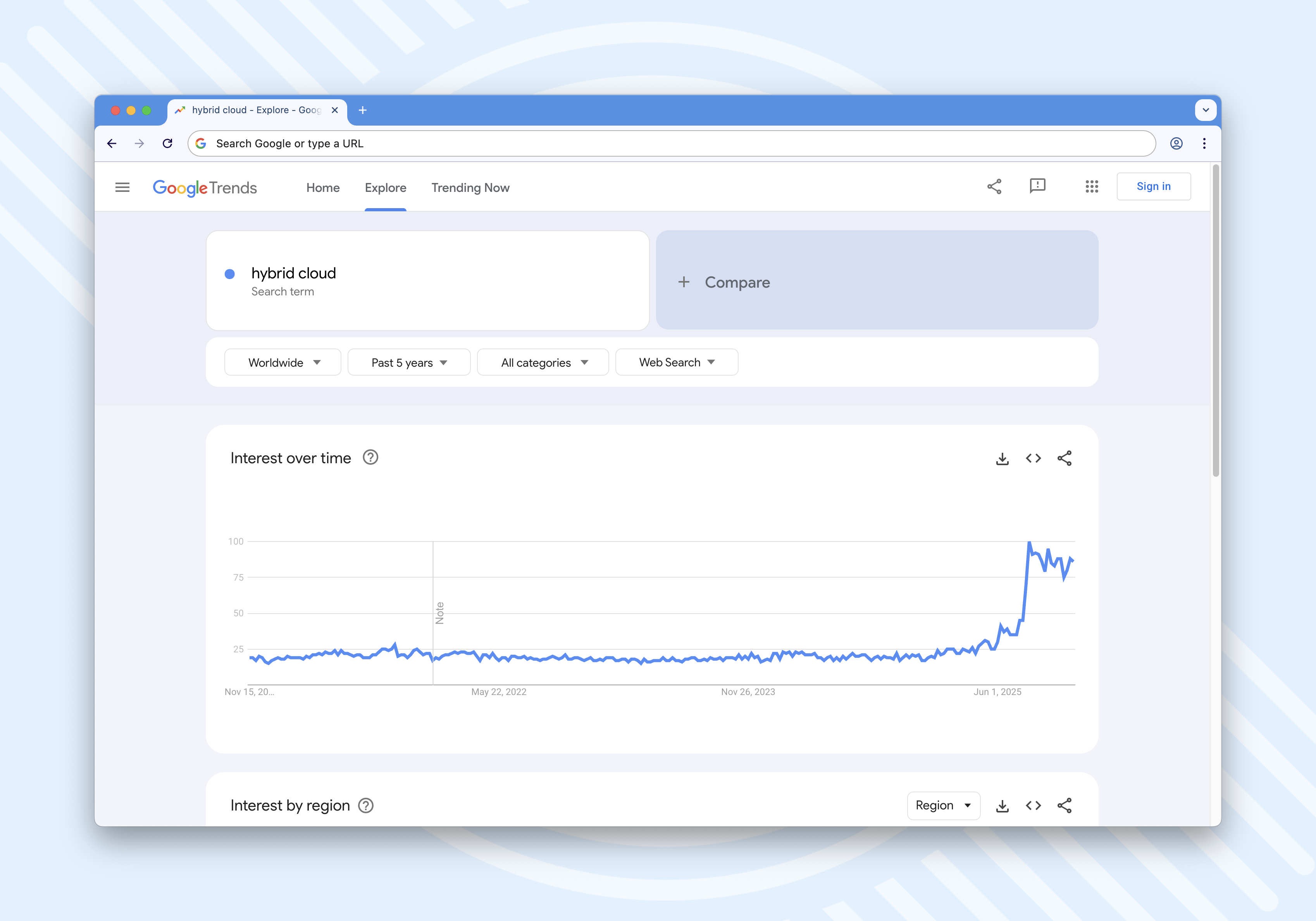
Google Trends from 2020-2025 for query "hybrid cloud"
Hybrid cloud is no longer an emerging concept. Google Trends data reveals a significant surge in interest around "hybrid cloud" over the past five years, with search volume reaching an all-time high level in 2025. This spike reflects a broader market shift as organisations move beyond cloud experimentation into mature, strategic deployments.
Decoding the cloud landscape: Enterprise deployment models
Understanding hybrid cloud requires distinguishing it from its component parts. The following table outlines the key deployment models available to enterprise organisations:
| Deployment model | Definition | Key enterprise use case |
| On-premises (air-gapped) | A completely isolated environment with no internet access or external network connectivity. Hardware, software, and storage are managed entirely within secure physical locations. |
Defence, intelligence, critical national infrastructure, and organisations handling classified or extremely sensitive data. |
| On-premises (traditional) | A traditional environment where the organisation runs and manages its own hardware, software, and storage within its physical locations (e.g., internal data centres), with standard network connectivity. | Legacy systems that cannot be easily migrated, latency-sensitive applications (e.g., manufacturing control, trading systems), and predictable workloads where cloud economics offer no advantage. |
| Private cloud | A cloud environment where all resources are isolated and operated exclusively for one organisation, offering cloud benefits (virtualisation, self-service, elasticity) alongside the control and security of on-premises IT. | Highly regulated industries (banking, healthcare, government) require strict compliance for sensitive data. |
| Hybrid cloud | A unified computing environment that combines and integrates public cloud, private cloud, and on-premises infrastructure to create a single, flexible IT ecosystem with workload portability. | Enabling workloads to move freely between platforms based on real-time needs (cost, security, compliance, performance). |
| Public cloud | Computing resources (like VMs or SaaS) hosted by a third-party cloud service provider and delivered over the public internet, typically on a pay-as-you-go basis. | Scalable development, customer-facing applications with fluctuating demand, and rapid adoption of new technology like AI. |
| Hybrid multi-cloud | An evolution where an organisation utilises services from more than one cloud vendor, combined with their private and on-premises environments, offering greater flexibility and reducing dependency on a single vendor. | Avoiding vendor lock-in, leveraging best-of-breed services, and meeting data residency requirements across regions. |
Hybrid cloud in practice: Matching workloads to environments
The real power of enterprise hybrid cloud lies in placing each workload where it belongs. Rather than forcing everything into a single environment, hybrid architecture lets organisations make intelligent decisions based on the nature of each workload.
- Sensitive data? Keep it in your private environment. Customer records, financial data, intellectual property, and anything subject to strict regulatory requirements stay behind your firewall where you maintain complete control over access, encryption, and audit trails.
- Customer-facing applications with fluctuating demand? Run them in the public cloud. E-commerce platforms, marketing websites, and customer portals can scale elastically during peak periods without requiring you to provision and maintain excess capacity year-round.
- Global operations? Distribute workloads geographically for better latency and compliance. Serve customers from regional data centres, meet data residency requirements, and ensure business continuity through geographic redundancy.
- Development and testing? Spin up environments rapidly in the public cloud, then deploy production workloads to whichever environment best fits your security and performance requirements.
- AI and analytics workloads? Leverage public cloud's massive compute capacity for training models and processing large datasets, while keeping the resulting insights and customer data within controlled environments.
The key is interoperability and orchestration, not just coexistence. Workloads should move between environments based on real-time business needs: cost optimisation, compliance requirements, performance demands, or capacity constraints.
Key advantages of hybrid cloud architecture
1. Cost optimisation
Unpredictable public cloud spending can quickly spiral out of control. Hybrid cloud offers a pragmatic balance: run predictable, steady workloads on private cloud or on-premises infrastructure with fixed costs, while leveraging public cloud's pay-as-you-go model for variable or seasonal workloads. This prevents overprovisioning and keeps costs closely aligned with actual usage.
2. Security and compliance
For organisations in regulated sectors, keeping certain data and services within a controlled environment is not optional; it is mandatory. Hybrid cloud security allows enterprises to reserve behind-the-firewall resources for sensitive, highly regulated workloads while still leveraging economical public cloud resources for less sensitive data. A unified platform enables consistent security and compliance policies across all environments.
3. Resilience and business continuity
Disaster recovery and high availability strategies are dramatically improved by hybrid cloud setups. The architecture enables built-in redundancy, ensuring that if one environment fails, whether due to an outage, cyberattack, or regional disruption, workloads can be shifted to another environment without halting operations.
4. Agility without abandoning stability
Hybrid cloud provides the flexibility to spin up public cloud resources for rapid development or testing while simultaneously keeping core systems stable and secure in a private or on-premises environment. This translates to shorter product development cycles, accelerated innovation, and faster time-to-market, without putting critical systems at risk.
WorkOps ecosystem in hybrid cloud environments
As workloads span environments, managing them becomes complex. Integration, data synchronisation, and maintaining consistent governance across disparate platforms pose significant challenges. IT teams must be fluent in multiple tools and platforms, creating potential skills gaps and operational friction.
This is where the principles of WorkOps become crucial.
WorkOps is the framework for the orchestration of work across teams, tools, and environments. It is the operational layer that can maximise the value of modern hybrid cloud architecture.
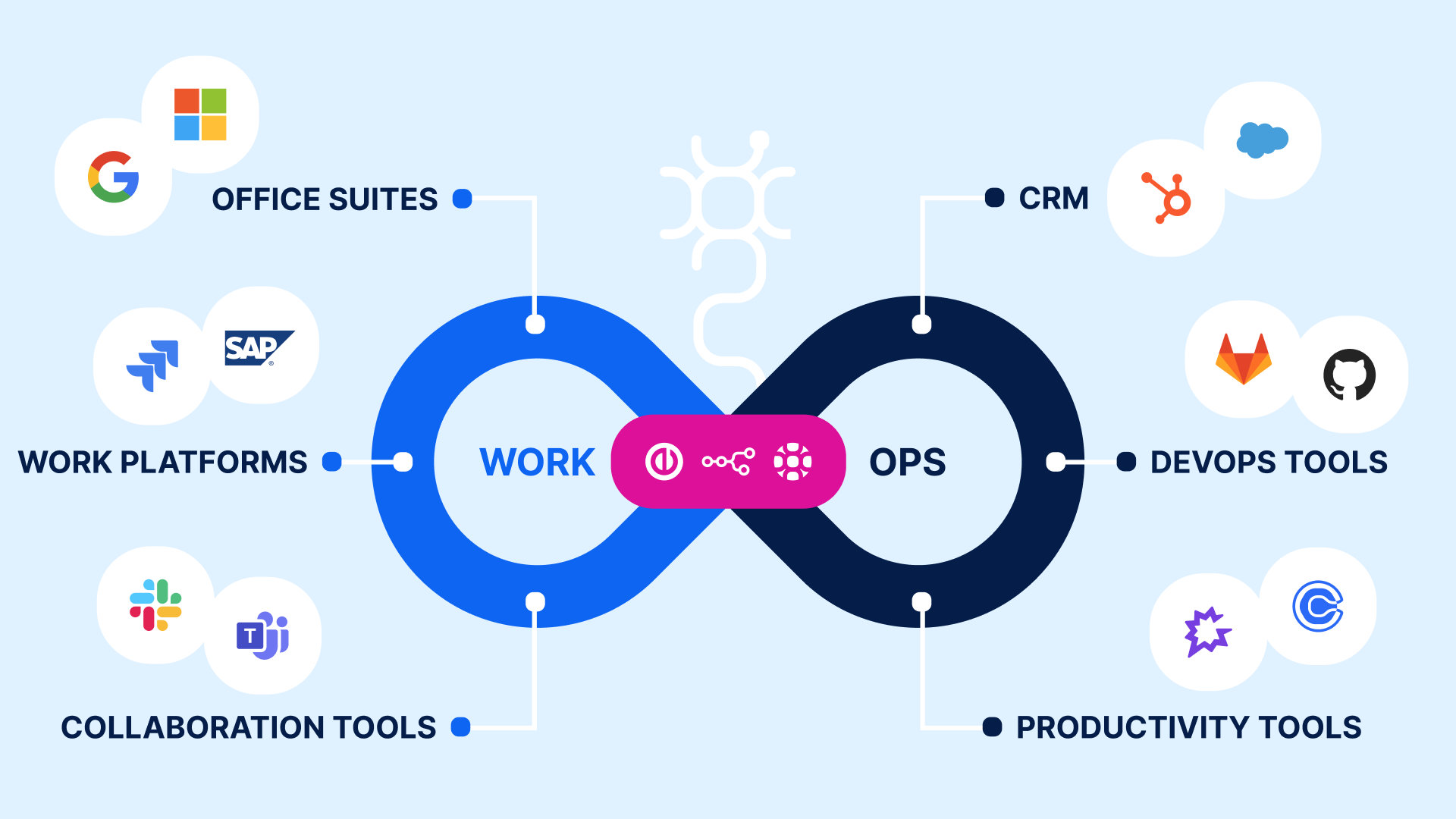
WorkOps infinity loop connecting enterprise tools
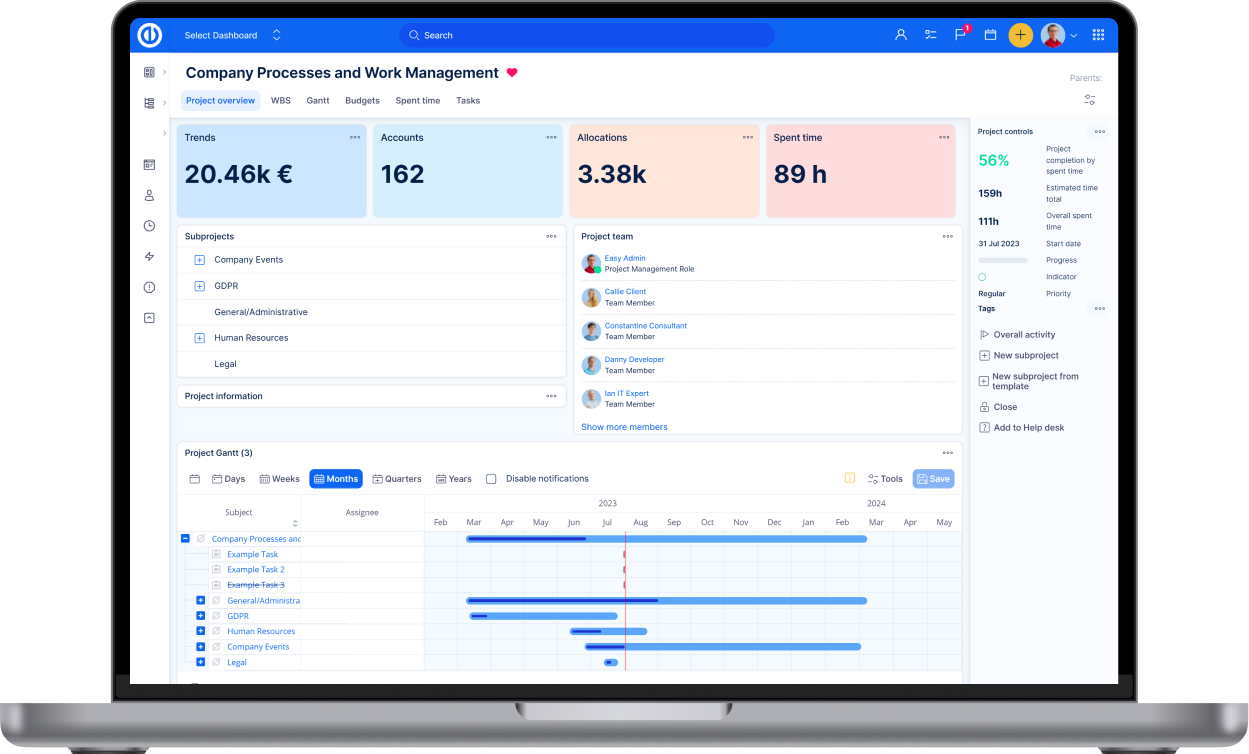
Whether your high-security projects (R&D, finance, government contracts) reside on your private cloud or on-premises data centre, while your marketing and customer service initiatives utilise public cloud offerings, Easy Redmine ensures unified visibility across all environments, orchestrated workflows that maintain consistency in compliance and governance, and alignment with your deployment strategy, enabling organisations to maintain control over where sensitive data is stored while still offering collaborative features to global teams.
By aligning with the WorkOps framework, Easy Redmine transforms the benefit of hybrid cloud (flexibility and control) into tangible operational efficiency.
Resilient hybrid cloud infrastructure
Hybrid cloud is not a technological compromise; it is a conscious, strategic choice to build infrastructure that works in sync with your business needs. It provides the adaptive, resilient foundation required to navigate complex challenges: balancing cost predictability with scalability, ensuring strict regulatory compliance while driving rapid innovation, and supporting modern workloads, including generative AI that require massive compute power.
If your organisation is navigating legacy systems, balancing data sensitivity with development speed, or seeking a smarter way to manage diverse IT requirements, enterprise hybrid cloud is the architecture that meets you where you are.
Unlock WorkOps in your hybrid cloud environment
Ready to transform your hybrid cloud architecture from a complex challenge into a competitive advantage?
Easy Redmine enables WorkOps across your private, public, and on-premises environments, ensuring your teams are connected, your data is governed, and your projects are delivered efficiently. Request a personalised demo today and learn how Easy Redmine supports tailored hybrid deployments.
Frequently asked questions
Related articles

How AWS and Azure cloud outages cost billions in October 2025
Isn’t the cloud supposed to be rock-solid? In October 2025, both AWS and Azure went down, taking major tools and services with them. On November 18 a bot-management bug caused a multi-hour global outage hitting services like X, ChatGPT and Spotify, while on December 5 a faulty firewall change caused a 25-minute disruption affecting LinkedIn, Zoom and other major sites. If it didn’t hit you, it easily could next time.

Why is project management not enough? Future of WorkOps explained
Traditional project management was built for a predictable, linear world that no longer exists. Today's problems, such as siloed teams, tool fragmentation, and rapid change, require an ecosystem approach, not project-by-project oversight. WorkOps creates an intelligent, interconnected work environment where automation, AI and humans combine to deliver continuous value. Let's deep dive into the topic.

The end of Jira on-premises: Atlassian Data Center terminates support
Atlassian is pulling the plug on Jira Data Center—and with it, the last on-premises option for Jira users. By 2029, support and updates will be gone entirely. The countdown has started: migrate to the cloud, plan a hybrid setup, or find a true on-premises alternative before the clock runs out.