Stop being the human bridge between apps: Try WorkOps framework
Too many tools, fragmented data, and frustrated teams? WorkOps is a modern framework that helps you orchestrate your existing tech stack instead of replacing it. Here's how to get started.

Table of contents
What is WorkOps?
How does WorkOps work in practice?
Can you start small?
Debunk the 'one-size-fits-all' software myth
TL;DR: WorkOps is a framework that connects your tools, teams, and processes through integration and automation. Instead of buying new software, you orchestrate what you already have. Start small, ask the right questions, and build continuous improvement loops.
What is WorkOps?
WorkOps is a framework that acknowledges a simple truth: you cannot find one tool that covers 90% of your processes. And that's fine. Instead of replacing everything, WorkOps shows you how to connect what you already have through integration, automation, and AI.
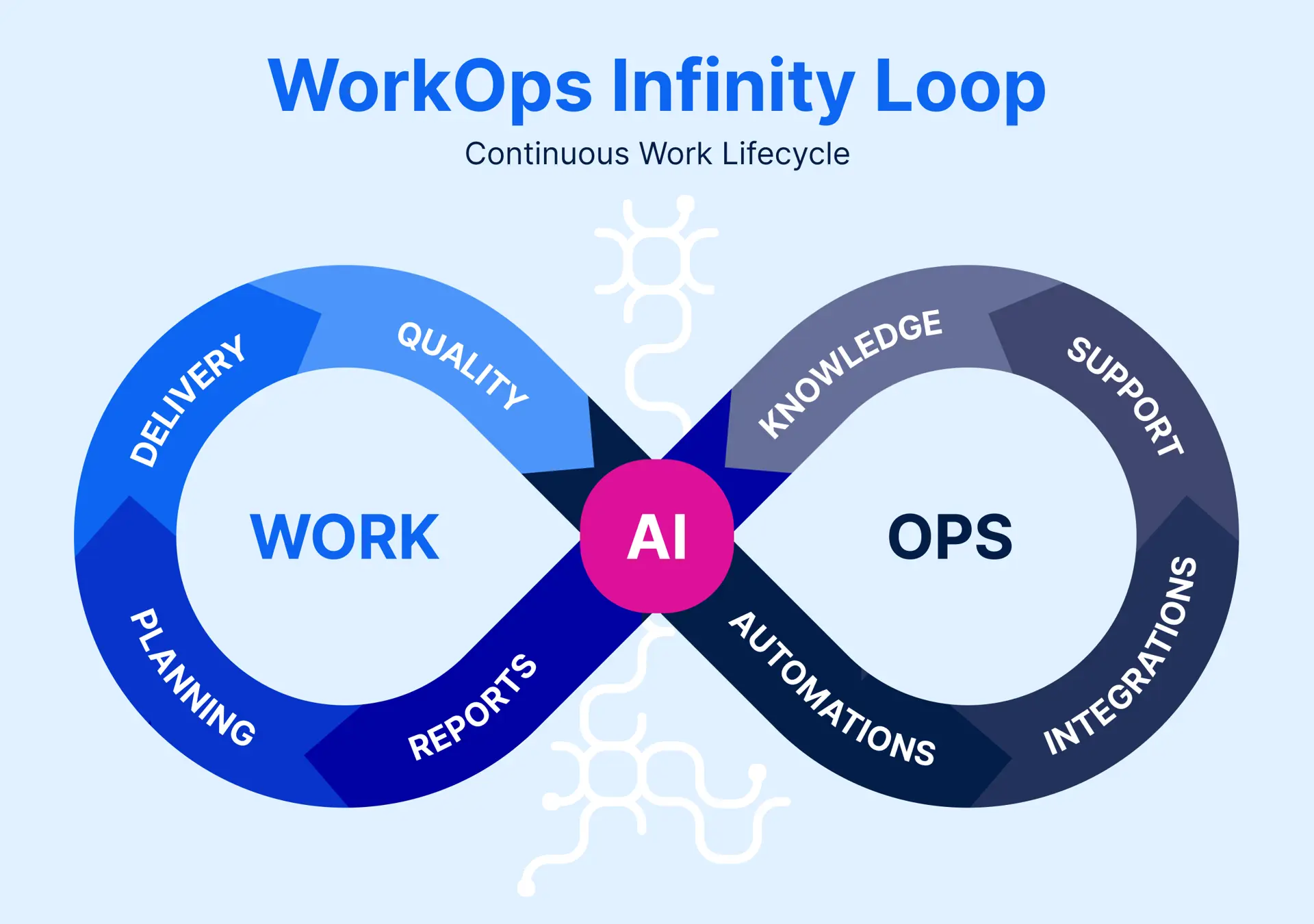
The core loop is simple. Each time through the loop, you improve based on lessons learned.
How does WorkOps work in practice?
WorkOps addresses four perspectives:
- Process perspective: focuses on the step-by-step "how" of work, defining clear input requirements and output expectations for every phase of the delivery loop.
- Organisational perspective: examines the "who," mapping out team responsibilities, communication standards, and how handovers occur between departments.
- Technical perspective: audits the "tools," evaluating the existing tech stack and identifying where an integration layer (like n8n) is needed to connect isolated softwares.
- Data perspective: ensures there is a "single source of truth" where information is accurate, accessible, and consistent across all platforms without falling through the cracks.
Can you start small?
Absolutely. Pick one workflow, like a service request. Take 30 minutes and ask:
- Which tools are used?
- Where do we copy data?
- Where are the bottlenecks?
- Where does ownership change?
You'll likely find these friction types: integration gaps, manual work, ownership confusion, or data fragmentation.
Fix just one.
Add a single integration, automate one manual step, or create one trusted dashboard. Measure the difference.
Debunk the 'one-size-fits-all' software myth
WorkOps drives efficiency by replacing the "one-size-fits-all" software myth with an integrated ecosystem where automated, system-triggered handovers and a continuous "knowledge loop" transform fragmented data into a unified, scalable delivery process.
Stop being the "human bridge" between your apps. Start leading!
Ready to learn more? Watch the full webinar recording to see practical examples and use cases, including how to calculate your potential savings and apply WorkOps principles to your own workflows.

Frequently asked questions
Related articles

Top strategic predictions for 2026: AI, project management, governance
Are you ready for the AI skills paradox? Gartner’s 2026 predictions reveal a future where AI reshapes not only business operations, but human thinking, global regulation, and economic power. The real question? Who controls AI—and who gets controlled.

COO's insight: Workflow automations and AI agents for operations
Smarter operations begin with visibility, the right focus, and a culture that is open to AI. Let's examine how Easy Redmine and Easy8.ai transformed daily challenges into practical automations and digital team assistants through the lens of the COO.

What is WorkOps?
First came DevOps to fix development, then RevOps to align revenue teams. Now WorkOps arrives to solve the biggest challenge yet: orchestrating how entire organisations get work done in an AI-powered, hyperconnected world. So, what is WorkOps?