Atlassian Data Center is ending. Keep your on-premises alive.
Switch to Easy Redmine and keep working the way you always have. Same wokflow, familiar issue tracking, without data loss.
Get a free migration pilot to evaluate Easy Redmine.
How the offer works
To apply the offer
1. Sign up for a free trial.
2. Contact sales and get a free demo & migration pilot.
Terms
- Validity: The offer is valid until June 30, 2026.
- Eligibility: Applies to Atlassian Data Center clients. The offer is available for Jira on-premises instances with 100+ users.*
- Migration scope: The free migration pilot applies to the Jira Software data (projects, issues, comment history, users, time entries, Jira key reference). Ask us about Confluence & Jira Service Management migration options.
Jira vs Easy Redmine comparison
While Jira is a standard for pure Agile teams, it often forces you to purchase additional plugins for complex project planning. Get the flexibility of Agile (Scrum/Kanban) with the structure of Waterfall (Gantt, WBS, Resource Management) in a single platform. Self-hosted.
|
Atlassian |
Easy Redmine |
|
|---|---|---|
| Project Management (Jira Software alternative) | Jira Software | Agile & Waterfall PM |
| Knowledge Management (Confluence alternative) | Confluence | Knowledge Base |
| Service Desk (JSM alternative) | Jira Service Management | HelpDesk |
| Git repository (Bitbucket alternative) | Bitbucket | GitLab/GitHub integration |
| On-premises (permanent) | ||
| Cloud deployment | ||
| On-premises AI | ||
| GDPR compliance, ISO certification |
Why is Easy Redmine the #1 Jira self-hosted alternative?
Agile & Waterfall project management in one platform
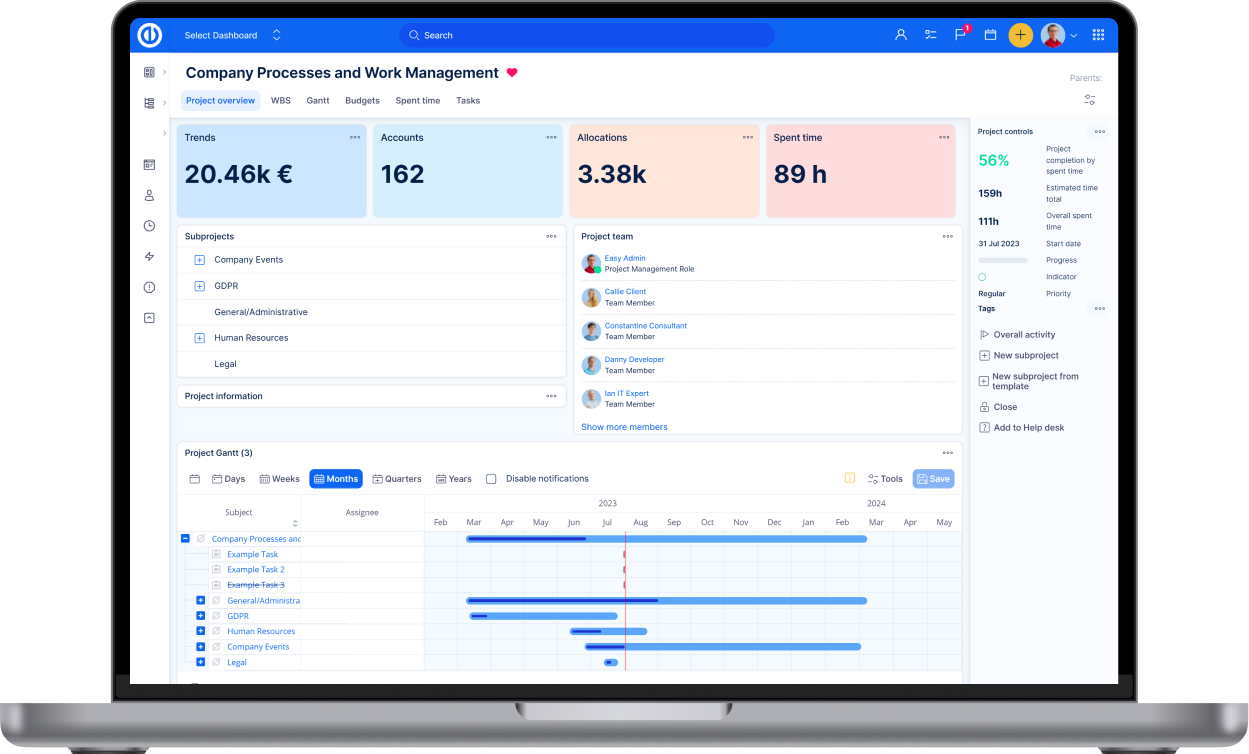
Easy Redmine Agile project management gives Jira users everything they’re used to—and even more with Waterfall features. Plan and track work on customizable Scrum and Kanban boards, manage backlogs and sprints, and link tasks with time tracking, resources, and reporting in just a few clicks.

Confluence self-hosted alternative
The Knowledge Base is a great alternative to Confluence. It centralises essential project, IT, and service information, making it easy for teams to access, share, and reuse know-how across all project phases, reducing duplication and speeding up issue resolution.

Jira Service Desk alternative
The HelpDesk in Easy Redmine integrates with project and service management, enabling efficient ticket handling, SLA tracking and faster issue resolution.
This alternative to Jira Service Desk lets users submit tickets via email or an intuitive interface. It sends automatic notifications, monitors SLA performance, and provides complete visibility into your support operations.

Software development with GitLab integration
While Jira integrates with Bitbucket, Easy Redmine offers native GitLab & GitHub integration. This brings repositories, merge requests, commits, and releases right into your project interface, giving your team complete visibility into development progress. All self-hosted, migration fully supported.
Setup is simple: name the repo, insert the URL and token, and then choose between automatic or manual syncing. This enables teams to link commit statuses and log time against tasks for better traceability and informed decision-making.

Workflow Automations & AI agents powered by n8n
With n8n integration you can connect Easy Redmine to over 1,000 apps and build no‑code workflows that sync tasks, trigger actions and reduce manual effort.
By embedding AI agents and automation workflows via n8n, your team can get real‑time alerts on risks, automatically escalate issues and standardise processes without constant supervision.
Case studies of Jira data migration to Easy Redmine

How a global IT company migrated data from on-premises Jira to Easy Redmine in just 2 weeks
IT services and consulting
When a technology-focused company found itself stuck with an unsupported Jira setup, the need for a secure, reliable alternative became urgent. With support from the Easy Redmine team and its built-in migrator, they managed to migrate 80% of their data within two weeks, all without giving direct server access, thanks to guided screen sharing.
The remaining 20%, including comments and attachments, which Jira could not export, and we could not import. Anyway, in just two weeks, their migration was almost fully complete, meeting both data protection and operational goals.

Data migration from Jira to Easy Redmine: Case study of Aspecta
IT Consulting
Jira handled issue tracking. But Aspecta needed to see the whole picture. Manage resources, budgets, and portfolios in one place. Here's how they made the switch to Easy Redmine.
How to safely migrate Jira on-premises to Easy Redmine
Start a free trial and contact sales for the free migration pilot. Explore how Easy Redmine and Jira migration works. Choose server or private cloud deployment options anytime.
Our experts will migrate your data from Jira. Choose a migration scope, and Jira migrator replicates your settings to ensure seamless continuity. No steep learning curve involved.
See for yourself, side-by-side, that all your projects, issues, and conversations have been accurately transferred and are fully functional in Easy Redmine. Secure migration, without data loss.


Why Easy Redmine works as your Jira on-premises alternative
With expert guidance and a structured three‑step process: enumerations migration, interim configuration and customisation, followed by full data import, Easy Redmine makes switching from Jira far less stressful.
Throughout the migration, you retain full visibility over your users, projects and tasks, and after migration, you run thorough user testing so everything works as expected in the new environment. For organisations with strict security requirements, private transfer is available.
Where all your tools finally talk to each other
Easy Redmine serves as an integration node in your tool stack ecosystem, connecting internal apps through our robust API. Enabling seamless data flow for issue tracking, project management, and activity management across your entire infrastructure.
As an official n8n Expert Partner, we help you build automation workflows connecting Easy Redmine to 1,000+ apps. From syncing tasks with your ERP to triggering alerts in your monitoring systems – your workflows, your rules. Enhanced by AI agents.
Frequently asked questions
Yes, Atlassian Data Center is going away and will reach its end of life on March 28, 2029. At that point, Data Center subscriptions will expire, and environments will become read-only, meaning no new updates, patches, or support will be provided.
This end-of-life applies to major Data Center products like Jira Software, Jira Service Management, Confluence, Bamboo, and Crowd, although Bitbucket Data Center is excluded and has a dual license model allowing cloud and Data Center use.
Atlassian Data Center and Server are two distinct self-hosted deployment models for Atlassian products (Jira, Confluence, Bitbucket, and others), each designed for different organizational needs and scales. The fundamental technical difference is that Data Center supports a multi-node cluster architecture while Server operates on a single application server.
While both offer the same core functionality, Data Center is purpose-built for enterprises requiring high availability, performance at scale, and operational flexibility, whereas Server is suited for smaller organizations with more modest deployment requirements.
Atlassian Data Center is a self-managed, enterprise-grade deployment platform for Atlassian products designed to meet the mission-critical needs of large organizations. It represents the evolution of Atlassian's self-hosted offerings following the end of Server support, combining advanced technical architecture with comprehensive enterprise capabilities to deliver high availability, scalability, and operational control.
Jira’s flexibility and depth come with a steep learning curve and significant administrative overhead, as teams must master complex configurations and dedicate resources to ongoing maintenance. Large instances can suffer performance bottlenecks and require disruptive re-indexing, while licensing and add-on costs quickly escalate.
Over-customisation risks process fragmentation and upgrade headaches, and native reporting tools are limited without additional plugins or BI integrations. Finally, the crowded UI and integration complexity can hinder adoption and create data silos if not carefully managed.
The process involves not only transferring raw data but also cataloging various entities crucial for the PM tool's operation, such as task types and statuses. Optimizing resources, including CPU, RAM, and HDD, is vital for maintaining application performance post-migration. Inadequate resource allocation can lead to decreased performance and productivity.
Many teams seek alternatives due to Jira's complexity, cost, or specific feature needs. Several tools offer compelling options, each with unique strengths suited for different kinds of teams and workflows. Among them is Easy Redmine, which provides open source solutions to 25+ team members.
Organizations considering switching from Jira may find Easy Redmine particularly appealing due to its hybrid project management capabilities, extensive feature set, greater data control, and lower operational costs—all crucial factors for modern, security-conscious, and cost-sensitive teams.
Jira Server and Jira Data Center both offered self-hosted deployments, but Server was designed for smaller teams with single-node setups and limited scalability, while Data Center provided enterprise-grade clustering, high availability, and support for thousands of users across multiple nodes.
However, Jira Data Center has reached end of life as of March 2029, with no new licenses or renewals after March 2028, leaving organizations without ongoing Atlassian support or updates.
For teams needing high-level security in a self-hosted environment, Easy Redmine stands out as a suitable replacement, featuring robust encryption, role-based access controls, GDPR compliance, and seamless Jira data migration for on-premises control.
Jira Data Center remains the only Atlassian-supported option for on-premises installation, deployable on your own physical hardware, virtual machines, or Kubernetes clusters. However, it faces end of life by March 2029, with no new licenses or renewals after March 2028, after which it becomes unsupported and read-only.
Jira Server, the original self-hosted edition, ended support on February 15, 2024, and is no longer available for new deployments.
For organizations requiring high-level security in a self-managed environment, Easy Redmine provides a robust on-premises alternative with enterprise-grade encryption, role-based access controls, GDPR compliance, and seamless Jira data migration tools. This ensures continued data sovereignty and ongoing updates without Atlassian's impending EOL constraints.
Yes, Jira Data Center supports on-premises deployment on your own physical hardware, virtual machines, or Kubernetes clusters, offering full control over infrastructure. It enables both single-node and clustered setups with shared home directories via NFS/SAN for high availability across multiple nodes.
However, with its end of life approaching in March 2029 (no renewals after March 2028), it lacks future support, security updates, or new features.
For sustained high-security on-premises needs, Easy Redmine provides a viable self-hosted alternative with equivalent scalability, encryption, and Jira migration tools. This shift ensures data sovereignty without Atlassian's EOL risks.
Jira Cloud is a fully hosted SaaS solution managed by Atlassian, offering automatic scaling, built-in AI features like advanced automation and predictive insights, and zero infrastructure maintenance. Jira Data Center, by contrast, runs on-premises or in your own cloud infrastructure, providing active-active clustering for high availability, extensive customization, and full data control via multi-node setups.
Cloud prioritizes ease of upgrades and rapid feature releases but limits deep customizations, while Data Center excels in performance tuning and compliance for large enterprises yet requires IT overhead.
Note that Data Center faces end of life in March 2029 with no renewals after March 2028, lacking future support.
For secure on-premises continuity, Easy Redmine offers a self-hosted alternative with comparable scalability, encryption, and Jira migration tools.
Migrating Jira data to a new server requires backing up the database, home directory, and installation files from the old server, then installing a fresh Jira instance on the new server and restoring the data. Perform this in a test environment first to verify compatibility and avoid production issues, especially given your prior Jira migration planning.
Cloud is usually chosen over on‑prem when you want flexibility, speed, and lower upfront cost, while on‑prem is better when strict control, data locality, or special performance needs matter most. Both have trade‑offs, so the “right” choice depends on your workloads, team, and compliance context.
However, consider on‑premises if:
- You have strict regulatory or data‑sovereignty constraints.
- You run stable, high‑volume workloads that justify hardware investment.
- Ultra‑low latency or deep customization is critical.
* Additional notes for the offer:
- Requirements: A valid company email is required.
- Verification: You may contact sales@easyredmine.com to confirm eligibility before signing up.
- Discretion: The offer is entirely at the discretion of the sales team and may be declined at their discretion.